
Indications & Benefits
Of Aquatic Therapy


Indication
Underwater treadmill therapy helps hasten the return to function of orthopedic and neurological patients. It offers a decreased weight-bearing environment that improves a limb’s functional utilization without significantly increasing weight loading and causing discomfort to a joint that has undergone surgery. When exercise is first started in the water, patients recovering from fractures when immobilization is required frequently perform well. Additionally, the viscosity of the water offers more proprioceptive and tactile stimulation.
Most postsurgical and neurologic patients also have some degree of muscular atrophy or strength loss. Additionally, muscle atrophy develops as a result of osteoarthritis and, to a lesser extent, as we age. Due to the greater resistance to forward motion, walking on an underwater treadmill once a week or more can help people with muscular atrophy improve strength and mobility. Strength can be developed much more quickly with sessions that occur more frequently-even every other day.
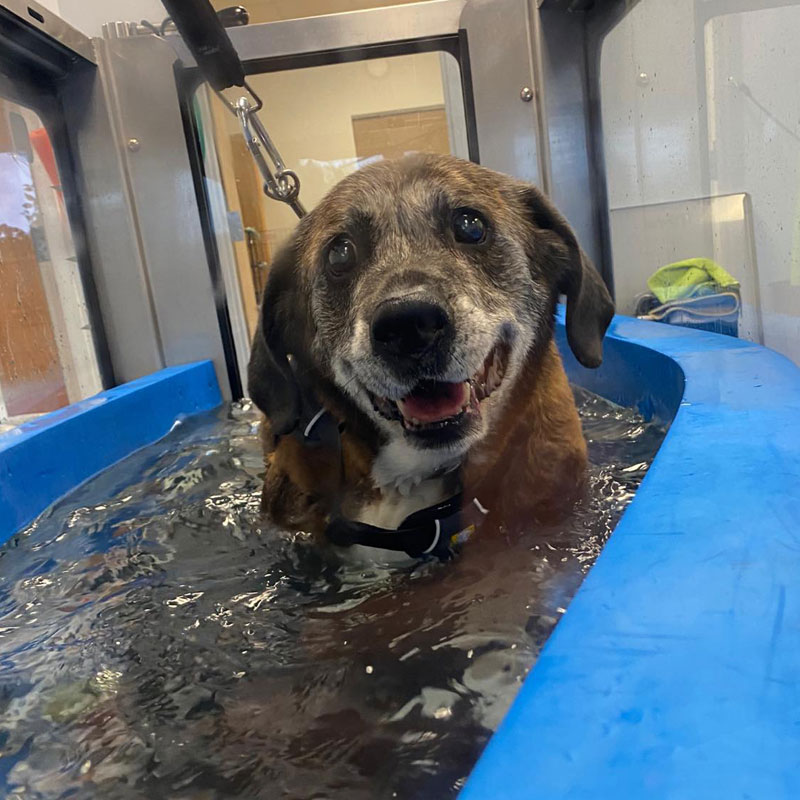
Indication
Underwater treadmill therapy helps hasten the return to function of orthopedic and neurological patients. It offers a decreased weight-bearing environment that improves a limb’s functional utilization without significantly increasing weight loading and causing discomfort to a joint that has undergone surgery. When exercise is first started in the water, patients recovering from fractures when immobilization is required frequently perform well. Additionally, the viscosity of the water offers more proprioceptive and tactile stimulation.
Most postsurgical and neurologic patients also have some degree of muscular atrophy or strength loss. Additionally, muscle atrophy develops as a result of osteoarthritis and, to a lesser extent, as we age. Due to the greater resistance to forward motion, walking on an underwater treadmill once a week or more can help people with muscular atrophy improve strength and mobility. Strength can be developed much more quickly with sessions that occur more frequently—even every other day.
Benefits
Because it is more comfortable and because the functional limbs’ resistance to forward motion delays the gait pattern, many dogs who are reluctant to use an injured limb may use it to help maintain balance and stability in the water. Small dogs who have femoral head ostectomy benefit the most from underwater treadmill therapy. Instead of extensive scar tissue that restricts motion in these patients, we desire good pseudojoint creation. In order to retain strength and balance in the rest of the body as well as to assist strengthen the muscles and tendons that surround this new joint, an underwater treadmill facilitates motion in a low-weight-bearing environment.
Reduced range of motion is frequently seen in injured joints. Walking on a treadmill while submerged in water enables a proper but exaggerated gait pattern, which enhances joint flexion and, to a lesser extent, extension. Patients with reduced stifle and hock flexibility following surgery to repair an anterior cruciate ligament damage are the most prevalent example of a patient who would benefit from this exaggerated gait pattern.
Warm water’s ability to relieve pain enables muscle relaxation and tendon stretching in cases when splinting, protection, or contracture has taken place. Because of the additional resistance provided by the water, athletes can build their muscles and boost their cardiovascular endurance by exercising on an underwater treadmill.
